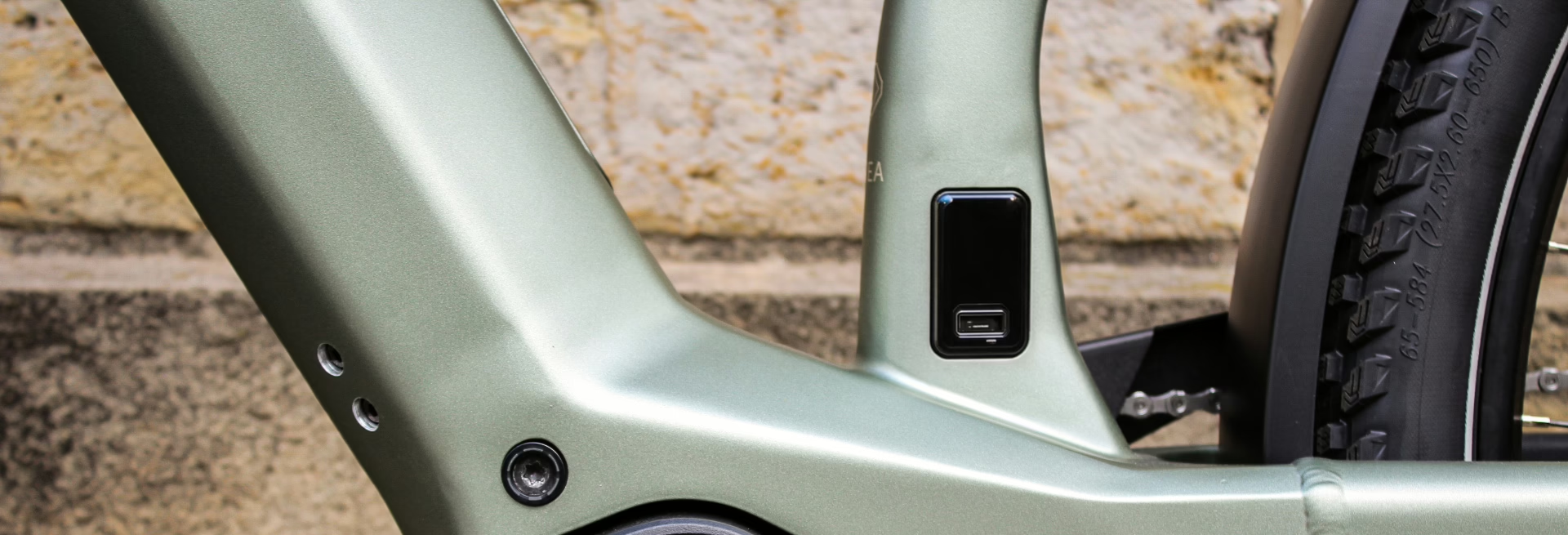
Why all e-bikes might charge with USB-C one day, but why they often better use proprietary chargers yet
USB-C is everywhere. And that’s a great leap forward for many consumer products. But why hasn’t this standard taken over e-bike charging as well? If it can charge your laptop, why not your newest Diamant e-bike?
The answer is simple: The battery is the complex, high-voltage heart of your e-bike. Simplicity, durability, and most importantly, safety, must always take precedence over convenience. Here is a look at what USB-C charging can already do and where they often still struggle.
1. Can USB-C charge fast enough?
Most people charge their e-bikes at home, at work, or during a generously long break on their day out. That’s great. And still, we want good charging speeds for the moments when we’re in a rush. To charge a battery with 600-800 Wh in a reasonable timeframe (say, in just a few hours), a standard charger needs to deliver a strong, steady current.
- Is USB-C too slow? The widely adopted Power Delivery (PD) standard theoretically allows up to 240 W, which theoretically is far more than your conventional e-bike charger requires. The vast majority of common USB-C chargers still run at 100W, but if you’re only after speed: USB-C chargers can nowadays keep up with proprietary solutions.
- Charge your Bosch-powered Diamant fast. Many manufacturers offer their bikes with 2 Ampere (2A) chargers. We at Diamant deliver all our Bosch-powered e-bikes with a fast 4 Ampere (4A) charger. At 42V, this translates to a charging power of approximately 168 Watts (W), ensuring a fast turnaround and consistent delivery as well.
If you only compare charging standards for speed, you might feel that USB-C chargers can already perform as good as proprietary chargers. However, read on and learn how there is more to consider.
2. Why are e-bike specific charging profiles a challenge for USB-C chargers?
Every charger has a charging profile that consists of a set of programmed and optimized parameters like voltage, current, and time. These profiles manage the charging process. Proprietary solutions allow motor manufacturers to finely tune the charging profile to your battery’s needs, and to deliver robust thermal management. That is not the case if you charge an e-bike with just any USB charger.
For instance, USB-C is specified for currents up to 5A. For most systems, that is not enough if the bike also features a range extender, adding to the electricity consumption of the main battery itself. Many people know similar warnings from their notebooks when they try charging their device with underpowered chargers.
Even without a PowerMore, your e-bike needs more tailored solutions. Most existing chargers operate at 28V. This voltage is not enough to charge powerful and large e-bikes batteries, which require between 42V and 58,8V. A DC/DC boost converter added to battery could bridge that gap. Sounds nice but takes space, adds weight, and increases complexity and cost.
What do you really gain when the charging port looks like a USB-C charger, but then it still requires a proprietary, bulky charger?
3. What about durability and weatherproofing?
Your e-bike shall endure rain, mud, grit, and thousands of connection cycles. The charging port must be equally robust.
The proprietary e-bike connector reflects engineering prowess for the rigors of cycling:
- Robustness: Proprietary connectors often feature larger, shielded contacts and a locking or deeply recessed design that can withstand the vibrations and minor misalignments of daily use much better than the delicate pins inside a slim USB-C port.
- Weather Sealing: The charging port on your e-bike needs an uncompromising seal against water and dust. The physical design of the specialized port allows for superior ingress protection (IP) ratings, ensuring that wet rides don’t lead to corrosion or a short circuit in the delicate charging electronics.
The universal USB-C port, while compact, has tiny, exposed internal pins that are highly susceptible to damage from dirt, moisture, and repeated, forceful plugging. It’s possible to overcome these problems. But for as long as USB-C charging doesn’t meet the power requirements yet, then a proprietary port design makes more sense.
💡 The right way to charge accessories
We understand the need to charge your phone or GPS on the go. Maybe that’s one of the most appealing features of USB-C charging on your e-bike. That’s why many Diamant bikes are equipped with, or can be easily upgraded with, the Bosch SmartphoneGrip.
The SmartphoneGrip uses a low-power USB output (typically 5V) specifically designed for accessories. This is the safe and appropriate use of USB on an e-bike: a separate, low-power connection for accessories that does not interfere with the high-voltage, high-current charging system required for the main battery. It keeps the high-power proprietary connection pure and secure. It also puts the USB-C charger where you want it to be, while the charging port of the e-bike battery stays in its own optimal position.
✅ The Diamant advantage: Optimized battery charging by design
There’s hype and there’s trust. At Diamant, our choice to exclusively use the Bosch motor system is a commitment to a complete ecosystem of power, safety, and reliability. This commitment extends right down to the charger you use. In this very moment, we consider Bosch’s offering as unrivaled, and we appreciate that their charging technology goes through extensive and rigorous development and testing.
You still benefit today of a proprietary charging system because it delivers:
- Optimized charging profiles: The charger communicates with the battery management system using a proven protocol to deliver the perfect voltage and current curve, protecting your investment and ensuring thousands of worry-free kilometers before requiring a replacement battery.
- The best resistance to the elements: You get fast, safe charging every single time, without the risk of rain, mud, and vibrations. Choose a Diamant e-bike, and you’re choosing a ride where every component, from the frame to the charging port, maximizes the life and performance of your most vital component: your battery.
Want to understand the technology that keeps your ride secure and powerful for longer?
Learn more about the advanced features of the Bosch Smart System on your Diamant e-bike and how it’s built for longevity.